The 1970s Nativity Set: Ceramic, Plastic and Paper-Mache
Mom's hand-painted ceramic Mary, the glowing plastic Joseph on the lawn, the little figures marked "Japan." Here's the crèche you set out every year.
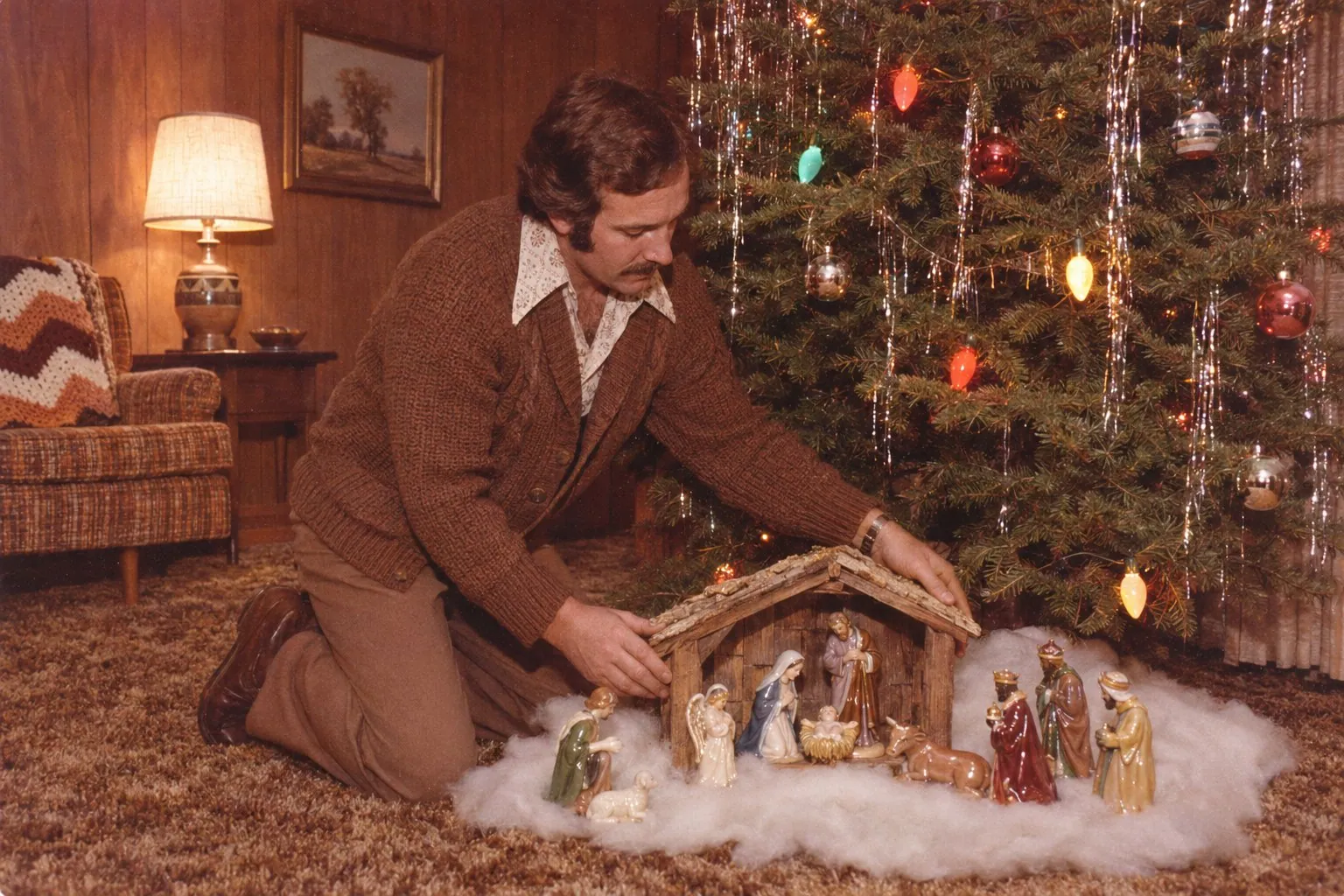
A 1970s nativity set usually looked like one of three things: shiny hand-painted ceramic figures from a ceramics class, hollow plastic figures lit from inside on the front lawn, or small paper-mache figures in a wooden stable under the tree. Most had somewhere between 10 and 20 pieces, with Mary, Joseph, the baby in the manger, an angel, shepherds, three wise men and an assortment of animals.
You probably remember exactly which kind your family had. You may also remember who was allowed to touch it. It was rarely the kids.
This article covers all three kinds and how families set them up each December. If your set is still packed in a box in the basement, you'll recognize a lot of this.
The set Mom painted at ceramics class
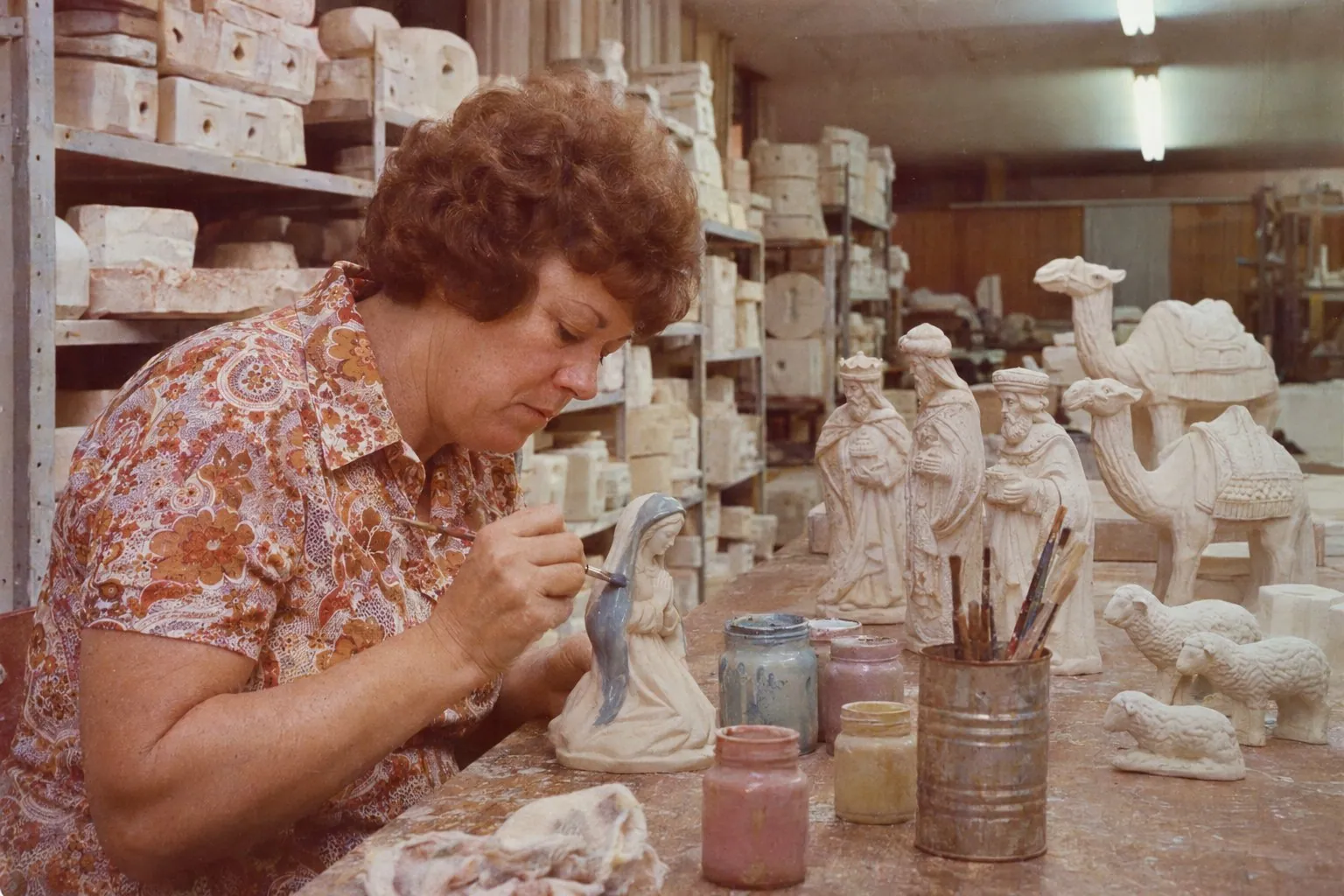
During the '70s, a lot of mothers and grandmothers spent one evening a week at a ceramics shop. Some shops were in strip malls, and some were in a neighbor's garage that had a kiln in the back. The shop poured liquid clay, called slip, into plaster molds. Students then bought the unfired pieces, known as greenware.
You took your Joseph home in a shoebox, or sometimes you worked on him at the long tables. First you scraped off the mold seams with a little knife and smoothed him with a damp sponge. After a firing in the shop's kiln, you painted him with glaze or stains. A whole set could take a good part of the fall, which is why so many of them first came out in December.
Most of the molds came from big makers. Atlantic Mold and Holland Mold were the names you'll see stamped on the bottoms of many of these sets. One Atlantic Mold set that turned up on eBay had 15 figures standing 6 to 9 inches tall, and the seller noted the mold stamp on the bottom. Another Atlantic set listed on Facebook Marketplace came with a ceramic stable 15½ inches tall.
Turn a piece over and you'll often find more than the mold maker's name. Many painters scratched their own name and the year into the bottom. An Etsy listing for a 20-piece Holland Mold set says it was painted in 1973 and signed "Lynn." That signature is the reason so many families won't part with these sets. Grandma's name is written on the bottom of the camel.
The paint jobs ran from soft browns and blues to bright, glossy colors with gold trim. Some painters used pearly, iridescent glazes that caught the tree lights. Many stables also had a hole in the back for a small bulb.
Read more: Ben Cooper Costumes: Who Dressed America's Trick-or-Treaters
The glowing Holy Family on the front lawn
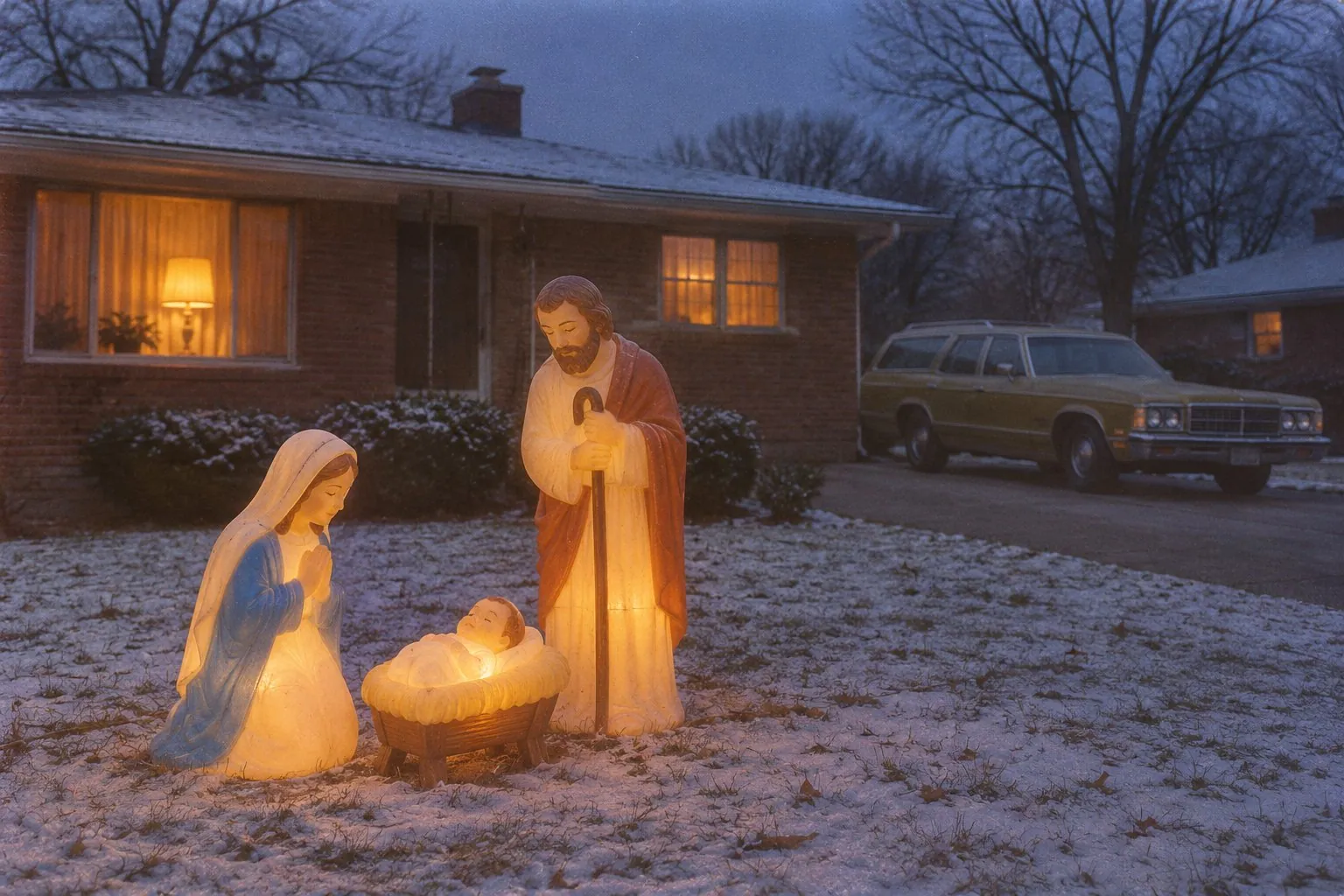
If you drove around town after supper in December, you saw them. A plastic Mary and Joseph knelt in a front yard, both lit from inside, with the baby in a manger between them. The light shining through the plastic gave them a soft, warm glow that no other decoration quite matched.
These were blow molds, made of hollow plastic and painted on the outside. A light cord ran up through a hole in the bottom. The best-known maker was Empire Plastics. According to the collector-run Blow Mold Wiki), Empire and later General Foam Plastics made the Mary, Joseph and Baby Jesus set from the late 1960s to 2017, and it was remade in 2024.
Look at the base of an old figure and you can often date it. A Mary offered on Etsy has "1976 Empire Plastics Corp." molded into the plastic. Families tended to add to the basic three pieces over the years, buying a wise man one Christmas and then a camel or a donkey later on.
You probably remember the work that came with them. Somebody had to run an extension cord across the lawn and change a burned-out bulb in the cold. Then you weighted the figures with sand or tied them to a stake so a December wind wouldn't knock Joseph into the hedge.
The little paper-mache figures from Japan
Plenty of families never bought a new set in the '70s at all. They set out the one they already had. In a lot of homes, that was a paper-mache crèche from the 1950s or '60s, with "Japan" stamped or labeled on the bottom.
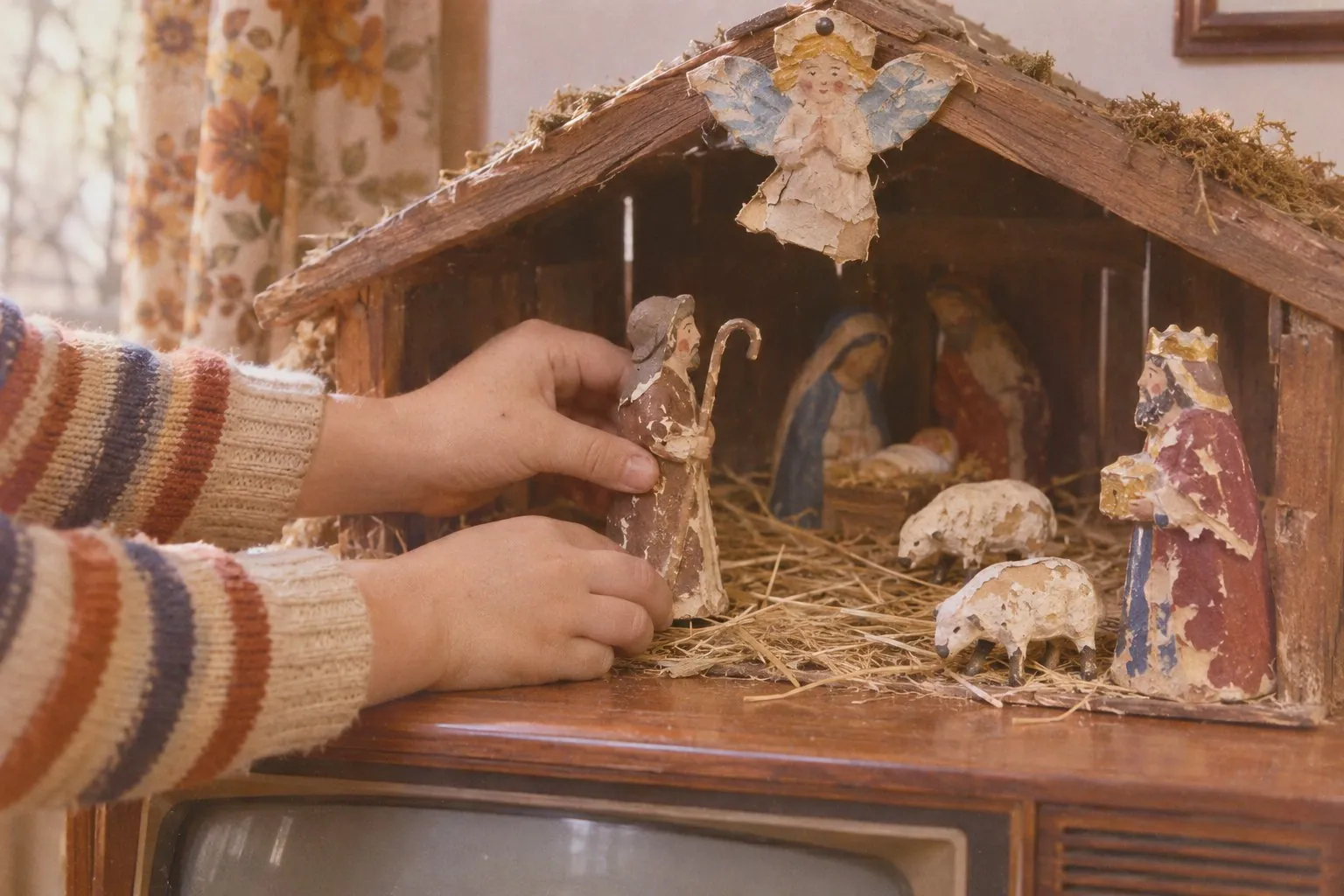
These figures were small and light, made of pressed paper or a paper-and-plaster mix and painted by hand. Some came glued straight onto the floor of a little wooden stable. Others came loose in a box with a cellophane window. One white paper-mache set sold on eBay carried the name of its importer, Consolidated Novelty Co., and the seller dated it to the 1960s.
Some had extras. Sellers today list paper-mache stables with a small light inside or a music box that played a carol when you wound it. If yours had one, you can probably still hear it.
By the '70s, many of these sets showed their age. The sheep had lost an ear, and a wise man's gift had been glued back on with whatever was in the kitchen drawer. Families kept putting them out anyway.
Under the tree: how families set up the crèche
Where the set went said a lot about a family. Some put it under the tree on a sheet of cotton batting, sometimes with a few strands of angel hair. Others gave it the top of the console TV, the piano or the mantel, out of reach of the dog.
Many households had rules about it. In plenty of homes the baby stayed in the drawer until Christmas Eve or Christmas morning. Some families started the wise men across the room and moved them a little closer each day until Epiphany on January 6.
Kids found ways to play with it anyway. A plastic farm animal or a toy soldier sometimes ended up standing with the shepherds. If you grew up with a ceramic set, you probably also remember the sound of a piece hitting the floor, and the quiet that came after it.
The custom itself is very old. Thomas of Celano, the first biographer of St. Francis of Assisi, wrote about the living manger scene Francis set up at Greccio, Italy, in 1223, with a real ox and donkey. The little stable on your family's coffee table came out of that tradition.
What those old sets are worth now
Most of these sets are worth more to the family than to anyone else. Still, they do sell. Etsy sellers ask about $90 to $175 for complete Atlantic Mold sets from the '70s. A single figure, such as one wise man or camel, often goes for $20 to $60.
Several things raise the price. Buyers pay more for a full set with the stable and for neat paint with no chips. A painter's signature and date also help. Large Empire lawn sets in good shape can go higher. One 9-piece lighted Empire set from the 1980s was listed at $359.99.
If you're unpacking your parents' set, turn each piece over first. The mold stamp, the year and the painter's name will tell you more than any price guide can. If you still have the original box, keep it.
Frequently asked questions
How can I tell what year my ceramic nativity set was made?
Turn the pieces over. Many hobby sets have the mold maker's name, such as Atlantic Mold or Holland Mold, and often a year stamped in. The person who painted the set sometimes scratched a name and date into the bottom too.
Who made the light-up plastic nativity sets?
The best-known maker was Empire Plastics. The collector-run Blow Mold Wiki says Empire and later General Foam Plastics made the Mary, Joseph and Baby Jesus set from the late 1960s to 2017. Many pieces have a molded year on the base.
Were paper-mache nativity sets made in Japan?
Many of them were. Hand-painted paper-mache sets marked "Japan" were common imports in the 1950s and '60s, and families kept using them through the '70s. Some carry an importer's name, such as Consolidated Novelty Co.
What is a 1970s ceramic nativity set worth?
Etsy sellers ask roughly $90 to $175 for a complete hand-painted set from the decade. Single figures usually sell for $20 to $60. Sets with the stable, clean paint and a painter's signature bring the most.
Sources
- Nativity Set (Empire/General Foam)), Blow Mold Wiki (collector reference)
- Thomas of Celano, The First Life of St. Francis of Assisi, c. 1229
- St. Bonaventure, The Major Life of St. Francis (Legenda Maior), 1260s
Related Stories
Love a trip down memory lane?
Get a fun quiz every morning. Free · One email a day · Unsubscribe anytime