1970s Christmas Lights: Big Bulbs, Minis and Bubble Lights
Hot C7 bulbs, a new string of tiny twinkle lights, and an hour on the floor hunting the one dead bulb. Here's how the tree got lit.
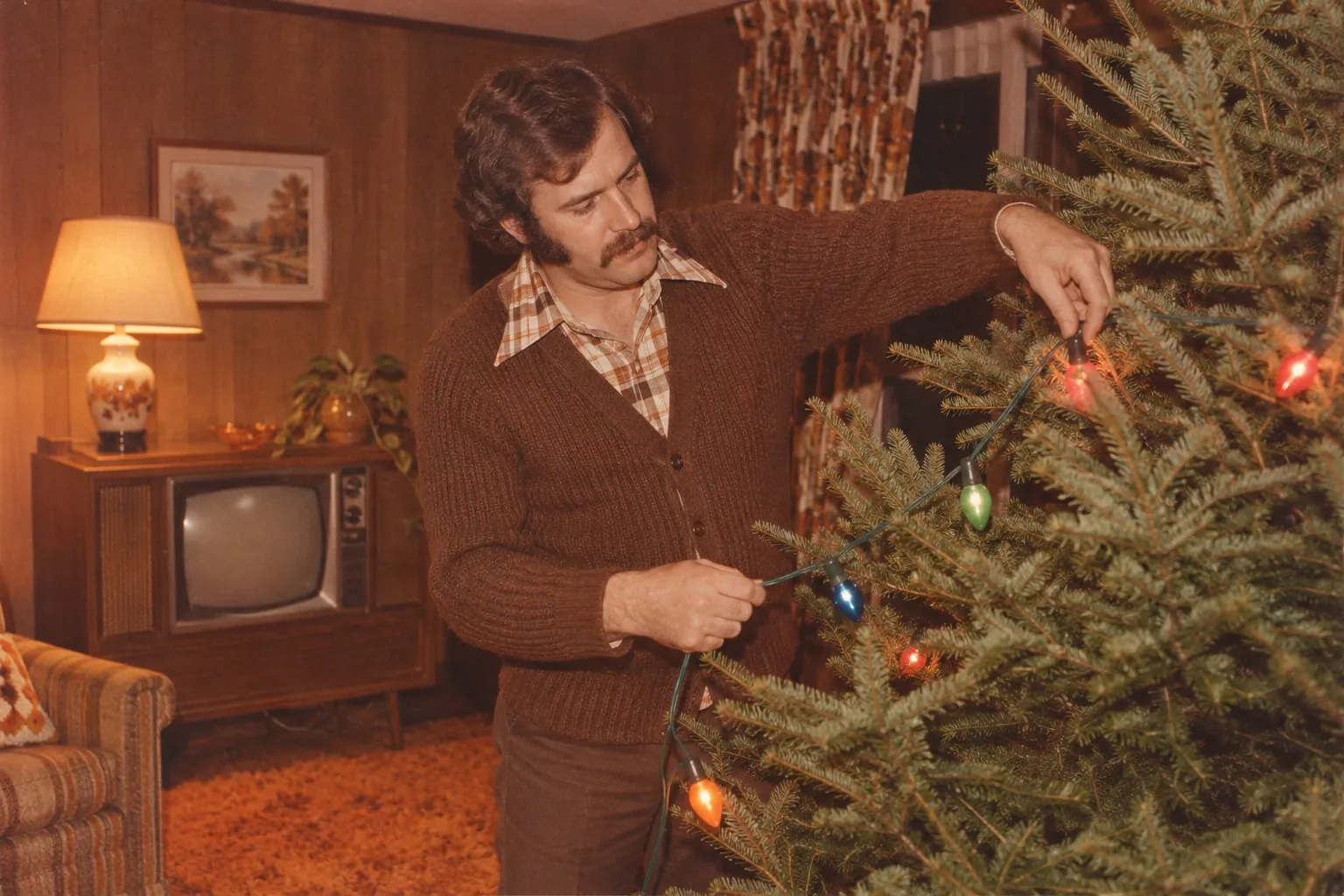
In the 1970s most American families lit the tree with big screw-in C7 bulbs and put the larger C9s outside, and during the decade the new miniature "Italian" or twinkle lights started taking over. A few families still brought out bubble lights from the '40s and '50s too. Those three kinds of 1970s Christmas lights made the decade a real changeover at home.
You probably remember both sides of that change. One year the tree glowed with fat red, green, blue and orange bulbs you could feel from a foot away. A few years later it sparkled with a hundred little points of light, and somebody in the house spent part of the evening on his knees looking for the one bulb that had killed the whole string.
The Big Bulbs Your Dad Wrestled With
The C7 was the standard tree bulb for decades. It was about the size of a thumb, cone-shaped, and it screwed into a socket the way a night-light bulb does. According to Family Christmas Online, each C7 was a full house-voltage bulb, so it didn't need series wiring to step the voltage down.
That was the C7's best feature. When one bulb burned out, the others stayed lit, and you could see the dark one right away. You twisted in a new one from the little cardboard box of spares and went back to your eggnog.
They also ran hot. Family Christmas Online notes that the ceramic-finish C7s "still got hot," which is why the sockets had little clips for aiming each bulb away from the needles. If you grew up with a real tree, you know the smell of warm dust and pine coming off those bulbs by the second week of December.
The C9 went outside
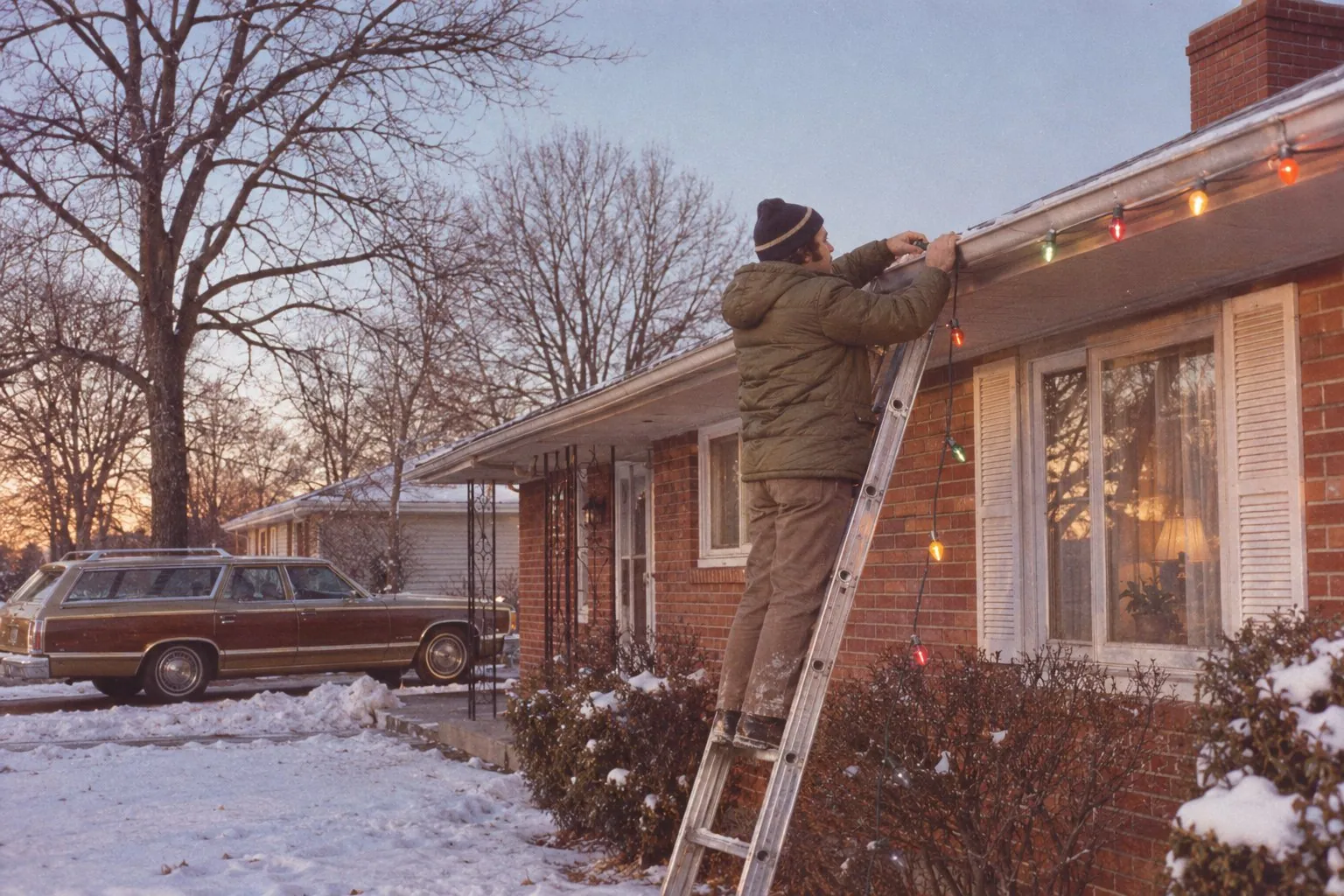
The C9 was the C7's bigger brother. As Family Christmas Online puts it, C7s didn't show up well outdoors and their strings weren't built for wet weather, so the larger C9 was adapted to keep rain and snow out. Those were the bulbs on the eaves, on the porch rail and in the blue spruce out front, and they were the ones Dad went up the ladder for on a cold Saturday.
The editor of Family Christmas Online also wrote that a C7 string bought in the early 1970s "still works great." Plenty of readers could probably say the same about a string in the garage right now.
Read more: Ben Cooper Costumes: Who Dressed America's Trick-or-Treaters
How 1970s Christmas Lights Went Miniature
The tiny lights weren't brand new in the '70s. The collectors' site OldChristmasTreeLights.com shows Italian sets from 1959 and the early '60s, including hand-blown bulbs with irregular glass. It also shows a NOMA/World Wide set made in Japan around 1961. Chris Cuff, a collector who writes for the site, has gathered Italian and American miniature sets from the late '50s through the 1970s.
The '70s were when the little lights caught on. How Products Are Made says the midget lights, midget twinkle lights and miniature Italian lights "became the best sellers of all time" in the Christmas tree light business. Some boxes said "midget," some said "Italian," and some just said "twinkle."
People liked them for good reasons. They were small enough to tuck deep into the branches, they ran a lot cooler than a C7, and a hundred of them made a tree look like it was full of stars. Clear white sets also looked right on a flocked tree or a silver aluminum one, though a color wheel still worked best on aluminum.
Testing Every Bulb on the String
The catch was in the wiring. HowStuffWorks explains that a mini bulb is a 2.5-volt lamp, not far from a flashlight bulb. The early strings wired 48 of them in a row so that 48 times 2.5 came out to 120 volts, the current from a wall outlet.
When mini lights first came out, HowStuffWorks says, one burned-out bulb darkened the entire strand. The electricity had to pass through every bulb, so one broken filament stopped it all. And because the whole string went dark, you couldn't tell which bulb had failed.
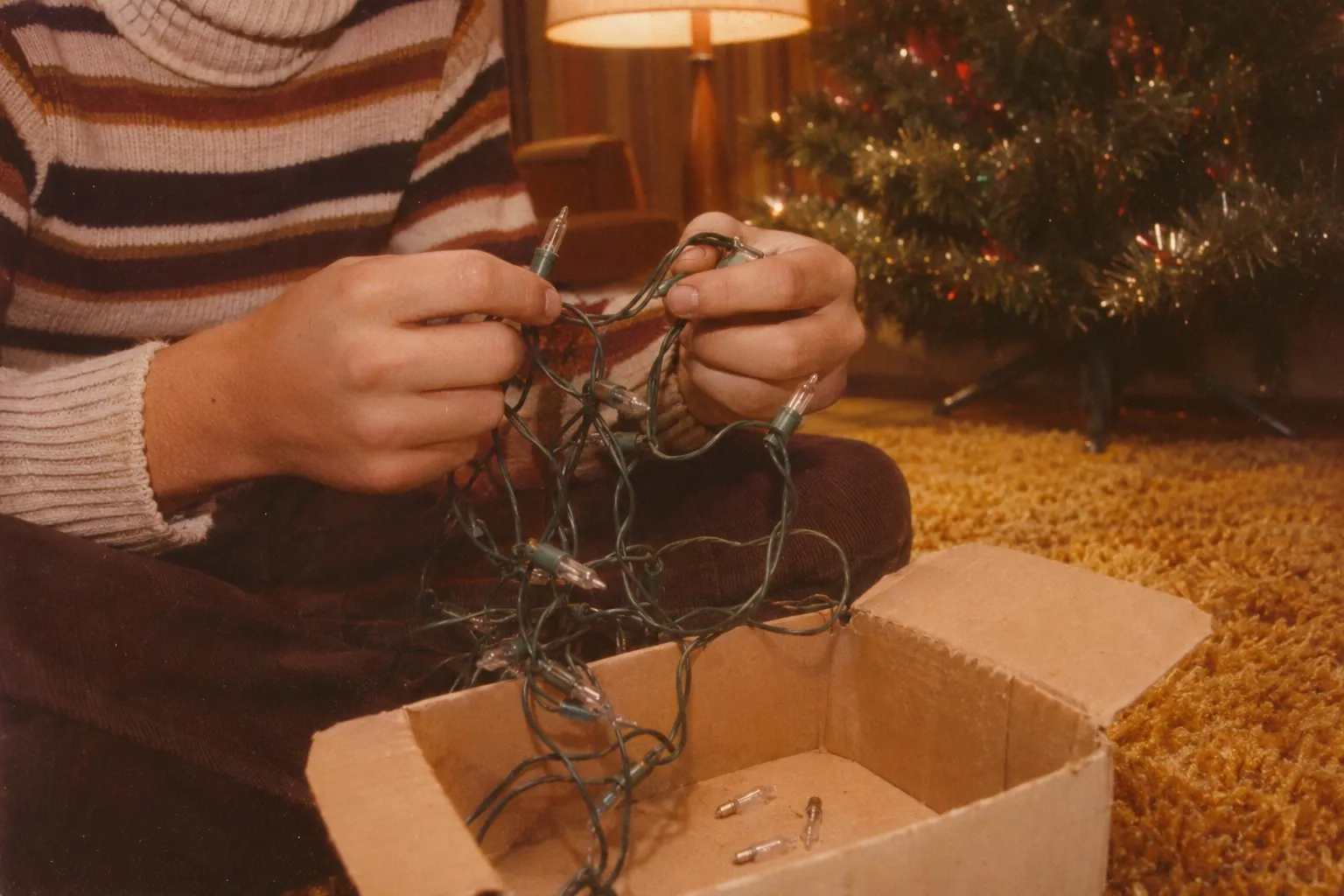
You probably remember how the fix went. You plugged the string in on the living room carpet, pulled one bulb, pushed in a spare you knew was good, and waited. Nothing. You put the old one back and moved to the next bulb, then the next, while the kids asked when the tree would be done.
Some families gave up and bought a new string. Others kept a coffee can of loose bulbs and fuses in the hall closet. Then there was the string that worked fine on the floor and went dark the minute it was on the tree, because one bulb had wiggled loose in its socket.
The old C7 strings never did that, which is one reason a lot of houses ran both for years, with big bulbs outside and minis inside.
Bubble Lights Came Out of the Attic
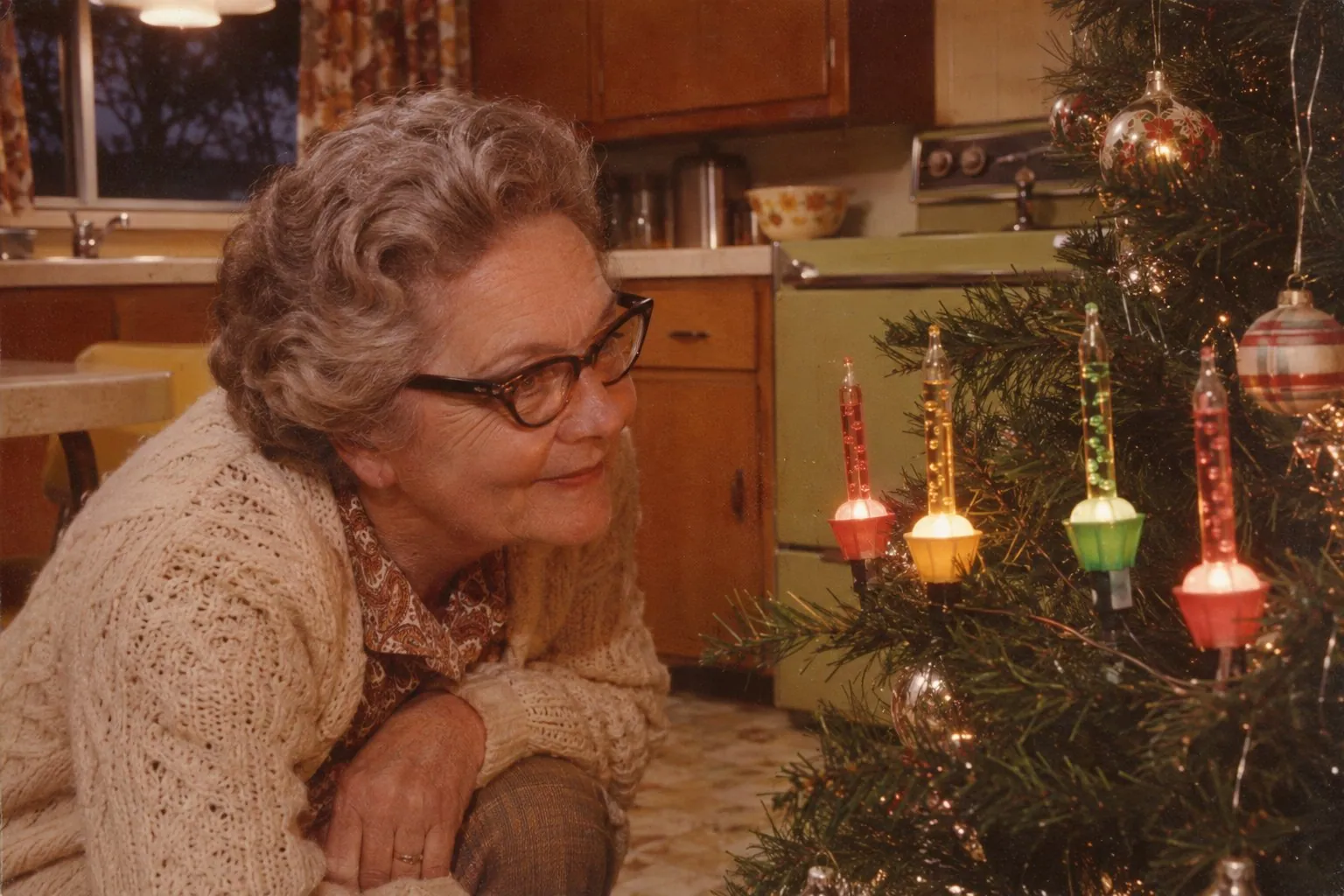
If your family had bubble lights in the '70s, they were most likely a set handed down from earlier. These were the candle-shaped tubes of colored liquid that started to bubble a few minutes after the set warmed up.
The story begins with Carl Otis. OldChristmasTreeLights.com says NOMA bought his patent rights and paid him a royalty of 3 cents a light (about 42 cents in today's money). The site adds that collectors still argue over whether the first ones were sold in 1945 or 1946.
In a 1989 Washington Post story, a source identified as Fay called Otis, a Montgomery Ward accountant, "a basement inventor." Fay also said NOMA sold 9.7 million of the lights in 1946, and that Otis collected more than $63,000 in royalties in 1947, about $888,000 today. According to Fay, sales later fizzled because the lights had become so popular, and by 1989 the Post was saying bubble lights were back.
The Christmas the Lights Dimmed
The 1973 energy crisis reached Christmas too. Four years earlier, National Park Service records show, President Nixon lit a National Christmas Tree with 9,000 small red and white lights.
In 1973, with the oil embargo on, The Washington Post reported that Nixon lit the National Christmas Tree with a single light. The Post also reported that he asked Congress for the power to cut back everyone else's outdoor holiday lights.
That was the year a lot of rooflines looked a little darker, and it gave many families one more reason to try the smaller, cooler mini lights.
Frequently asked questions
What kind of 1970s Christmas tree lights did most families use?
Most trees early in the decade had C7 bulbs, and C9s went outdoors. Through the '70s more families switched to miniature twinkle lights, which How Products Are Made calls the best sellers in the business's history.
Were there "1970s fairy lights"?
Yes, though few Americans called them that. "Fairy lights" is mostly a British term. American boxes usually said midget lights, Italian lights or twinkle lights, the names How Products Are Made lists.
Why did a whole string of mini lights go out when one bulb died?
The early sets wired 48 bulbs of 2.5 volts in a row, HowStuffWorks explains, so the current had to pass through every bulb. One broken filament stopped it for the whole string.
Are vintage 1970s Christmas tree lights safe to use today?
Old wiring can crack and C7 bulbs run hot, so check every cord for brittle or bare spots before plugging it in. Many collectors keep their originals for display and use new strings on the tree.
When were bubble lights invented?
Carl Otis filed his first bubbling-display patent application on November 27, 1935, OldChristmasTreeLights.com reports. NOMA put Bubble Lites on sale around 1945 or 1946, and collectors still disagree on the year.
Sources
- 1969-1973 National Christmas Trees, National Park Service
- The year the lights on the National Christmas Tree were dimmed, The Washington Post, 2024
- Celebrations, The Washington Post, 1989
- History of Bubble Lights, OldChristmasTreeLights.com
- A Brief History of Christmas Tree Lighting, Family Christmas Online
- How Christmas Lights Work: Christmas Mini-lights, HowStuffWorks
Related Stories
Love a trip down memory lane?
Get a fun quiz every morning. Free · One email a day · Unsubscribe anytime