How the Old Color Wheel for a Christmas Tree Worked
A lamp, a slow motor and a disc of colored plastic turned a silver tree red, blue, green and gold. Here's how it worked and why it was needed.
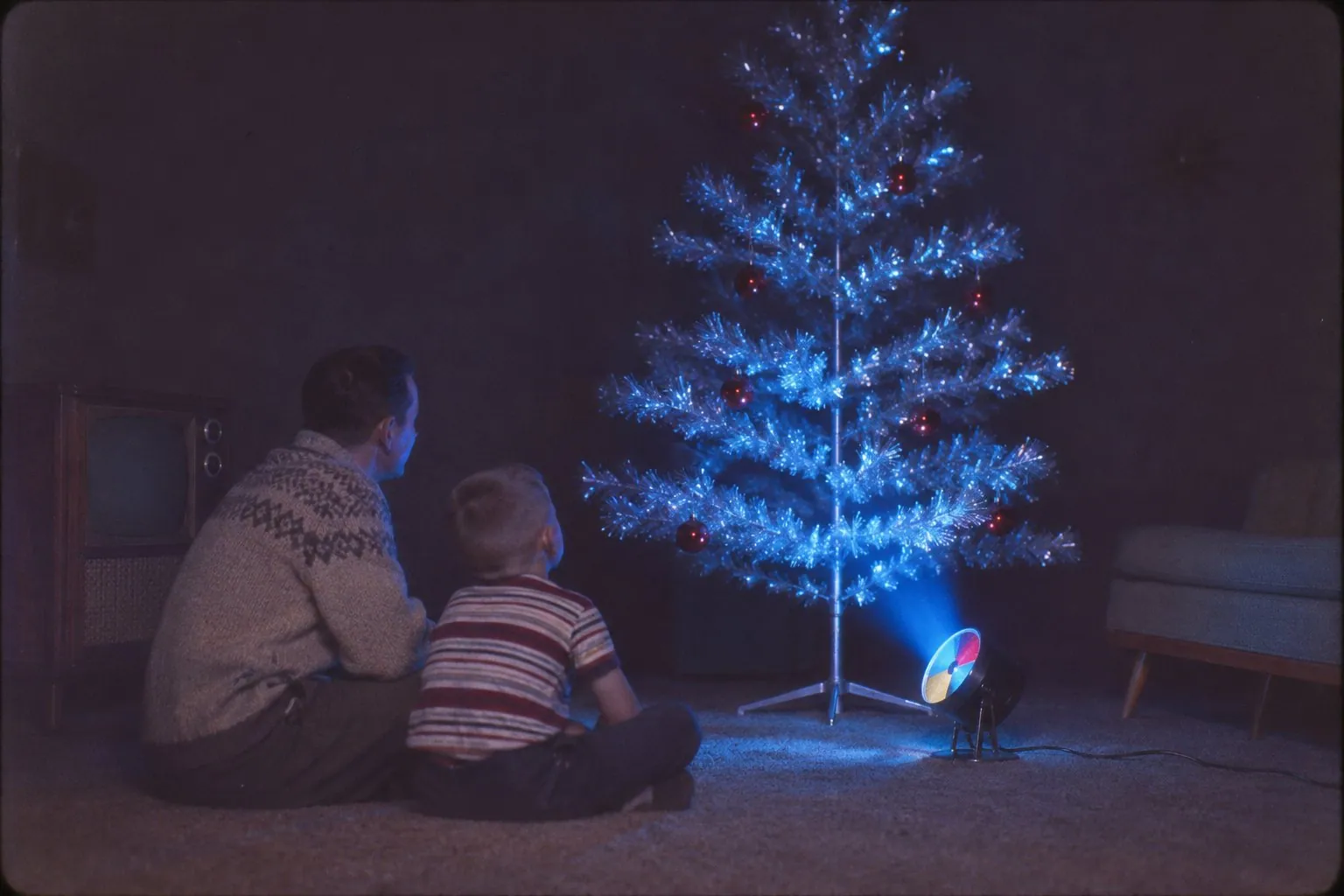
The old color wheel for a Christmas tree was a floodlight that sat on the floor. A small electric motor slowly turned a plastic disc of colored panels in front of the bulb, so the tree went red, blue, green and gold in turn. Aluminum trees got one instead of a string of lights because the metal branches conduct electricity, and a bad wire could charge the whole tree.
You probably remember the setup. The wheel sat on the carpet a few feet from the tree, pointed up at the branches. Somebody turned off the lamps, and the family watched a silver tree become a blue one, then a red one.
You may also remember the low hum of the little motor and the warm smell of a hot bulb that had sat in the attic all year. That smell meant Christmas had started.
How the color wheel for a Christmas tree worked
There were only three working parts, and that's why so many of them are still around.
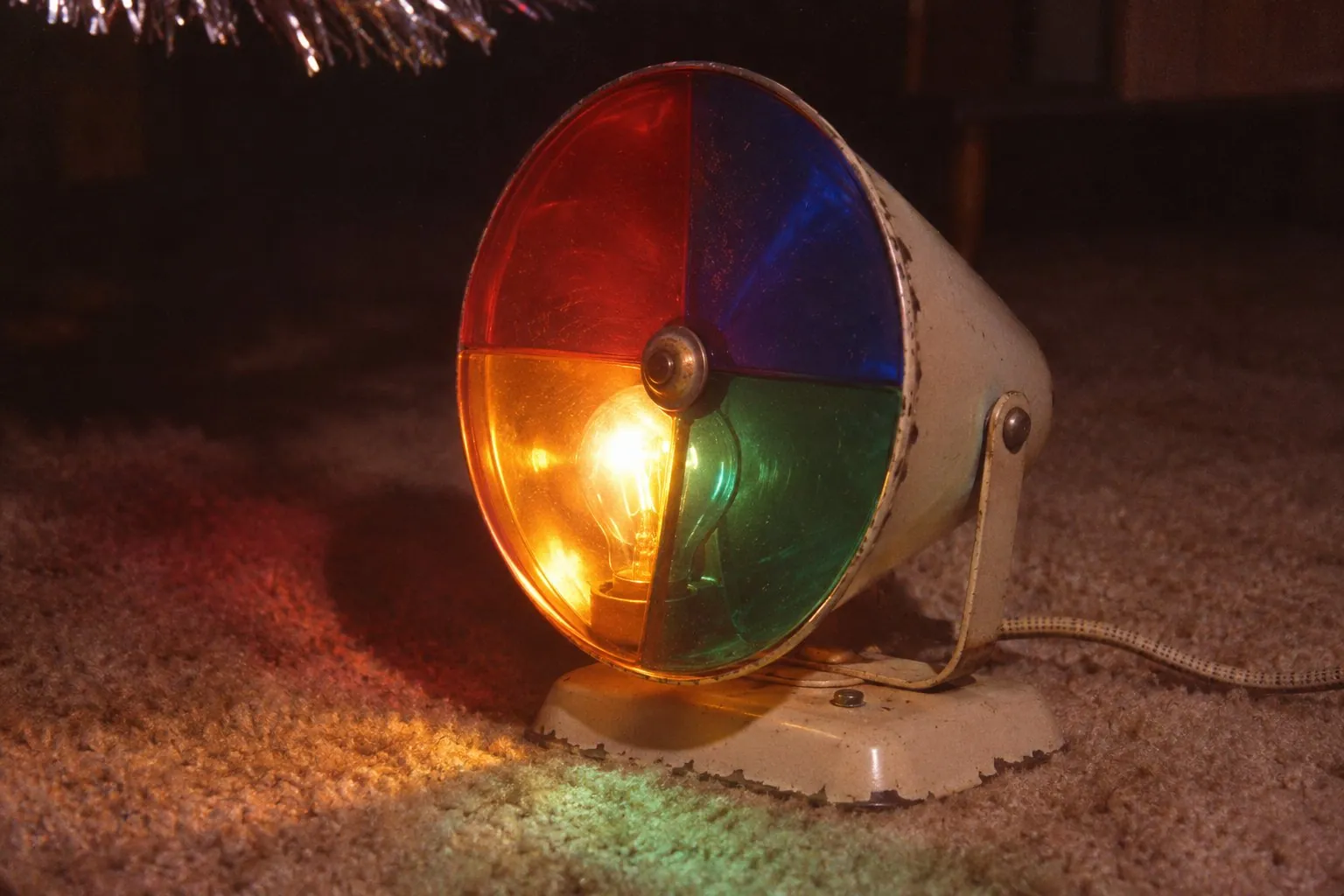
- The lamp. A regular incandescent bulb sat inside a metal hood with a shiny reflector behind it. The reflector pushed the light forward into a beam.
- The disc. A round disc of clear plastic sat in front of the bulb, split into colored sections like slices of a pie. In most wheels, the colors were red, blue, green and yellow or amber.
- The motor. A small, slow electric motor turned the disc. Each color passed in front of the bulb, and the beam on the tree changed from one color to the next.
Nothing on the tree itself was wired. The light came from across the room and bounced off the foil needles, which is why a silver tree seemed to shimmer. An Omaha Magazine piece described a collector's wheel turning her tree blue, red, green and yellow as each color crossed the bulb.
Some families also set the tree on a rotating stand, so the tree turned while the colors changed. If you had both, the living room looked like a nightclub for about a minute before Dad said it was making him dizzy.
Read more: Ceramic Christmas Tree Mold: How the Old Trees Were Made
Why you couldn't string lights on a metal tree
Aluminum conducts electricity. In the '50s and '60s, Christmas lights had thin wires and big hot bulbs. If a worn cord or cracked socket touched a metal branch, the whole tree could become live. Anybody who reached in to hang an ornament could get a shock, and a short could start a fire.
That warning still stands. The U.S. Consumer Product Safety Commission tells people, "Never use electric lights on a metallic tree," as Retro Renovation pointed out to readers in 2009. Its editor, Pam Kueber, noted that color wheels seem to have been made largely to get around that danger.
The wheel fixed the problem neatly. All the electricity stayed in one metal box on the floor, a few feet from the branches. The tree held nothing but glass balls, usually in one solid color.
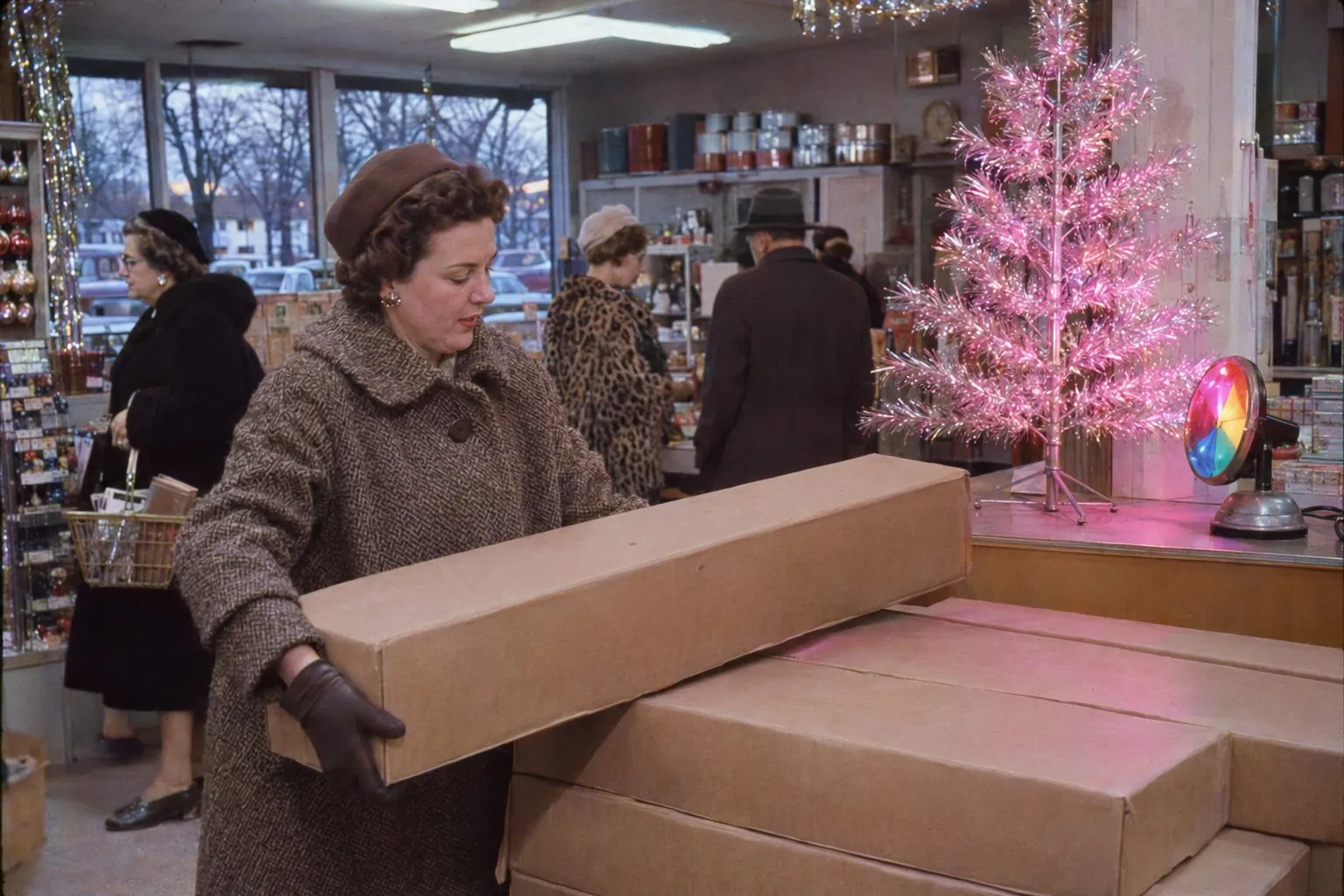

Evergleam, the tree from Manitowoc
The aluminum tree came out of Chicago first. Modern Coatings Company got a patent for one in 1955, The Maui News reported in 2017. Those trees were handmade and expensive.
Jerry Waak, who sold Evergleams and later became the company's vice president of marketing and sales, remembered the prices for WUWM in Milwaukee. In 1958, a four-foot tree was $75 (about $818 today) and a six-foot tree was $100 (about $1,090). A store buyer asked Aluminum Specialty Company of Manitowoc, Wisconsin, to make one cheaper and put it in a box a shopper could carry home.
According to The Maui News, the company's toy sales manager, Tom Gannon, bought one of the Chicago trees in December 1958. Engineers took it apart and redesigned it with foil needles so it could be made for under $12 (about $130 today). The next Christmas, the company sold all 10,000 trees it had rushed out, at around $25 each (about $270 today). Omaha Magazine says the Evergleam was shown at the 1959 American Toy Fair.
Waak told WUWM the plant ran 24 hours a day, ten months a year, and that the tree lasted 13 years on the market. Other companies made aluminum trees too. In a PBS Wisconsin talk, curator Joseph Kapler counted 12 to 15 makers around the country and called Evergleam the Coca-Cola of the business.
The company sold its own wheel. The Wisconsin Historical Society has an Evergleam Motorized Color Wheel from the mid-1960s in its collection. The society notes that Evergleam owners usually lit their trees with color projectors.
Why the silver tree needed the light
Kapler explained the idea to the Wisconsin State Journal in 2013. He estimated that about 80 percent of Evergleams were silver, and owners lit them with color wheels or fans with colored lights at the base. "It's a completely different effect than a dark green tree," he said.
Without the wheel, a silver tree in a dark room was just gray. With it, the tree changed color every few seconds, and that was the whole point.
The Evergleam had its best years in 1964 and 1965, the State Journal reported. Then in December 1965, "A Charlie Brown Christmas" aired. Lucy tells Charlie Brown to buy the biggest aluminum tree he can find, and he brings home a scrawny real one instead. The State Journal reported that Aluminum Specialty stopped making the trees in 1972.
How to tell a real vintage one
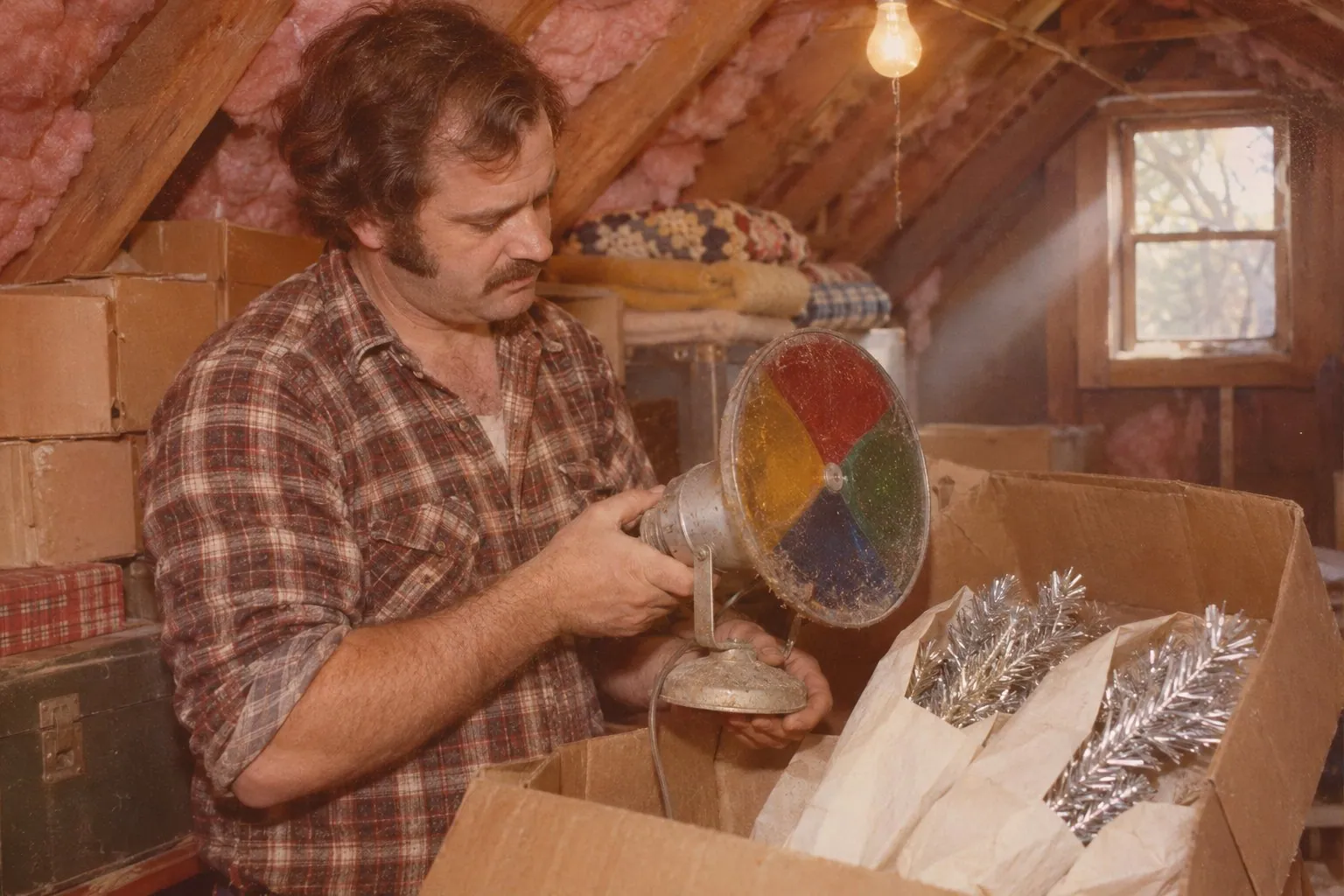
Plenty of new wheels are sold today, so here's what usually marks an old one:
- An incandescent bulb. The old wheels used an ordinary hot bulb. New ones, like TreeTronics' Color Wheel 2.0, are small LED units, and some come with a remote control.
- A metal hood and a separate plastic disc. On the old wheels, you can see the disc turning in front of the lamp.
- An old cord and plug. Look for a two-prong plug without a wider blade, and a cord that may be stiff or cracked.
- Wear from years in storage. Look for faded or warped color panels, scratched paint and a box that has been taped and retaped.
- The hum. If it runs, a little motor noise is normal on an old one.
One caution: if you dig yours out, have the cord checked before you plug it in. A cord from the '60s and a hot bulb are a bad combination.
What it cost then and what it's worth now
The trees' prices are well documented, from $25 for the 1959 Evergleam to $75 and $100 for the earlier Chicago trees. We couldn't find a reliable store price for the wheel by itself. The wheels were sold right alongside the trees, in many models and at many stores.
Today, an authentic vintage color wheel sells for closer to $200, while new reproductions start at about $35, Atomic Ranch reported. Kapler told WUWM that he values the trees' accessories and original packaging as much as the trees. A wheel in its original box is worth more than one without it.
Frequently asked questions
Why did aluminum Christmas trees use a color wheel instead of lights?
The aluminum branches conduct electricity, so a damaged light string could charge the whole tree. The U.S. Consumer Product Safety Commission still warns never to put electric lights on a metal tree. The color wheel kept all the wiring on the floor, away from the branches.
How does a rotating color wheel for a Christmas tree work?
A bulb with a reflector shines through a disc of colored plastic. A small motor turns the disc slowly, so the beam changes from red to blue to green to yellow. The foil needles reflect each color as it comes around.
Did Evergleam make its own color wheel?
Yes. The Wisconsin Historical Society has an Evergleam Motorized Color Wheel from the mid-1960s in its collection. Aluminum Specialty Company of Manitowoc, Wisconsin, made the Evergleam trees from 1959 until it stopped in 1972.
How much is a vintage Christmas tree color wheel worth?
An authentic vintage wheel sells for about $200, according to Atomic Ranch. One in its original box brings more. New reproductions start at about $35.
Is it safe to use an old color wheel today?
It can be, but have the cord and socket checked first. Cords from the '50s and '60s are often stiff or cracked, and the old bulbs run hot. Keep the wheel away from paper, curtains and the tree skirt.
Sources
- Ever Gleaming: Celebrating America's Aluminum Christmas Tree, Wisconsin Historical Society
- Museum's 'Evergleam' Christmas trees have a special nostalgic sparkle, Wisconsin State Journal, 2013
- Remember Aluminum Trees? Wisconsin-Made Evergleams Are Making A Comeback, WUWM Milwaukee Public Radio, 2013
- How Charlie Brown killed the aluminum Christmas tree, The Maui News, 2017
- Aluminum Christmas trees: An important caution, Retro Renovation, 2009
- The Evergleam Aluminum Christmas Tree, PBS Wisconsin, University Place
Related Stories
Love a trip down memory lane?
Get a fun quiz every morning. Free · One email a day · Unsubscribe anytime